
Adjective: เหนื่อย (hnèuay)
Meaning: is tired / is exhausted / is fatigued
In this Thai lesson, we learn how to use the adjective เหนื่อย (hnèuay), which means ‘is tired,’ ‘is exhausted,’ or ‘is fatigued.’ It describes a person’s physical or mental state after using energy, working hard, exercising, or dealing with difficulties.
The typical structure usually follows the pattern: subject +เหนื่อย (hnèuay).
For examples (ตัวอย่างเช่น — dtūa-awyàang chên)
ฉันเหนื่อยจากการทำงาน
chǎn hnèuay jàak gāan-thām-ngāan
Literal: I tired from the action of working.
I am tired from working.
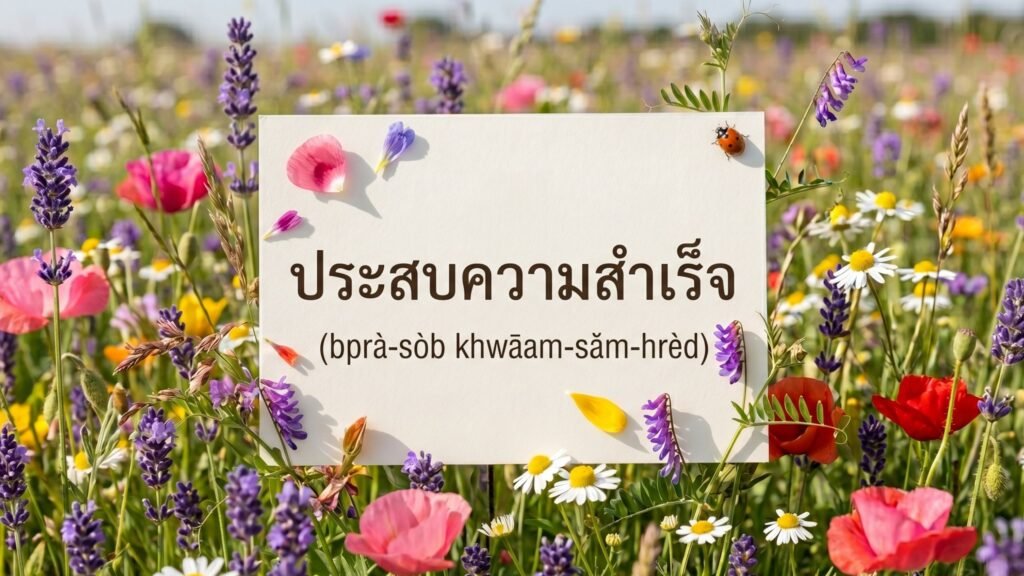
The prefix การ (gāan) is used before a verb to turn it into an abstract noun. It is similar to English ending like -ing (learning, reading), -tion (education, violation), or -ment (development). It is used to talk about actions, processes, concepts, or activities. It is like saying ‘the act of doing something’ or ‘the process of doing something’ — การ (gāan) + verb. For example: การเรียนภาษาไทยสำคัญมาก (gāan-rīan phāa-sǎa Thāi sǎm-khān mâak = Learning Thai is very important.); การทำงานหนักช่วยให้ประสบความสำเร็จ (gāan-thām-ngāan hnàk chûay hâi bprà-sòb khwāam-sǎm-hrèd = Working hard helps achieve success.); การละเมิดความเป็นส่วนตัวเป็นเรื่องผิดกฎหมาย (gāan-lá-mêuhd khwāam-bpēn-sùan-dtūa bpēn rêuang phìd gòd-hmǎai = Violation of privacy is illegal.), etc.
เขาเหนื่อยจากการเดินทาง
khǎo hnèuay jàak gāan-dēuhn-thāang
Literal: He tired from the action of travelling.
He is tired from travelling.
The preposition จาก (jàak) means ‘from’ and is used to show the starting point, origin, source, or sender of something — จาก (jàak) + place / person.
ฉันเหนื่อยที่จะต้องอธิบายเรื่องเดิมซ้ำแล้วซ้ำเล่า
chǎn hnèuay thêe-jà dtâwng à-thí-bāai rêuang dēuhm sám-láew-sám-lâo
Literal: I tired to have to explain matter same as before over and over again.
I am tired of having to explain the same thing over and over again.
The word ที่จะ (thêe-jà) means ‘to,’ ‘that will,’ or ‘in order to’, depending on context. It is used to connect a clause and a verb — clause + ที่จะ (thêe-jà) + verb phrase. It introduces an action that will happen, is intended, or is being planned.
ฉันเหนื่อยแล้ว ขอฉันพักก่อน
chǎn hnèuay láew, khǎw chǎn phák gàwn
Literal: I tired already, may I rest first.
I am tired; let me rest first.
The verb ขอ (khǎw) means ‘to ask for,’ ‘to request,’ or ‘to seek permission.’ Whenever you use this verb, you are asking someone for something — whether it is an object, an action, permission, or a favour.
Homework (การบ้าน — gāan-bâan)
Practise putting your newly learned Thai word into a sentence by translating the following sentences below.
- I am tired after working all day
- He is very tired but still keeps trying.
- Are you tired today?
- Mum is tired from looking after the children.
- He is still working even though he is tired.
About Post Author