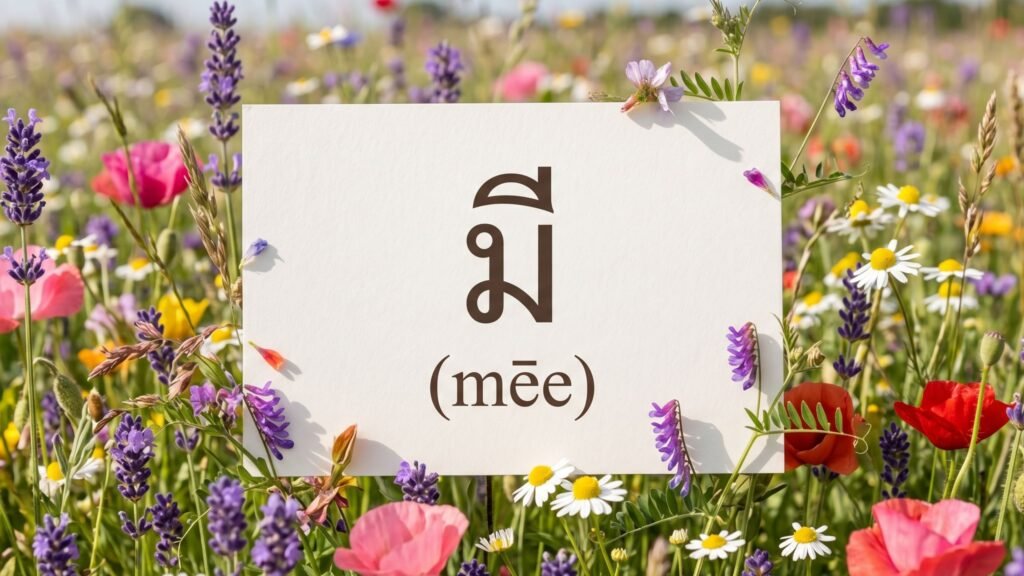

Verb: ซื้อ (séu)
Meaning: to buy
In this Thai lesson, we learn how to use the verb ซื้อ (séu), which means ‘to buy.’ It describes the action of obtaining goods or services by paying money. The focus is on the buyer, who acquires ownership of something in exchange for payment.
The typical structure usually follows the pattern: subject + ซื้อ (séu) + noun.
For examples (ตัวอย่างเช่น — dtūa-awyàang chên)
ฉันซื้อรถจากเพื่อน
chǎn séu ród jàak phêuan
Literal: I buy car from friend.
I bought the car from a friend.
The preposition จาก (jàak) means ‘from.’ It is used to indicate the starting point, source, origin, or sender of someone or something. It tells us where someone or something comes from, begins, or originates — จาก (jàak) + place / person.
พวกเรามักจะซื้อผักจากตลาด
phûak-rāo mák-jà séu phàk jàak dtà-hlàad
Literal: We usually buy vegetables from market.
We usually buy vegetables from the market.
The adverb มักจะ (mák-jà) means ‘usually,’ ‘tend to,’ or ‘often.’ It is used to describe habits, typical behaviour, or things that happen regularly. Rather than referring to something happening at a specific time, it expresses what is generally true or what commonly happens — subject + มักจะ (mák-jà) + main verb.
ฉันซื้อของขวัญให้แม่
chǎn séu khǎwng-khwǎn hâi mâe
Literal: I buy present to give mother.
I bought a present for Mum.
The word ให้ (hâi) can function as a main verb meaning ‘to give’ — subject + ให้ (hâi) + direct noun + indirect noun. For example: แม่ให้เงินลูก (mâe hâi ngēuhn lûuk = Mum gave her child some money.). It can also means ‘to let’ or ‘to allow’ someone to do something — subject + ให้ (hâi) + person + verb. For example: แม่ให้ฉันไปเที่ยว (mâe hâi chǎn bpāi-thîew = Mum let me go out.). It can also means ‘for’ or ‘to’ when the action is performed for another person’s benefit — subject + verb phrase + ให้ (hâi) + person. For example: เขาแปลภาษาไทยให้ฉัน (khǎo bplāe phāa-sǎa Thāi hâi chǎn = He translated Thai for me.).
เขาซื้อโทรศัพท์ใหม่
khǎo séu thōo-rá-sàb hmài
Literal: He buy telephone new.
He bought a new phone.
The adjective ใหม่ (hmài) means ‘is new.’ It describes something that is new and is placed after a noun — noun + ใหม่ (hmài). For example: เขามีรถใหม่ (khǎo mēe ród hmài = He has a new car.).
Homework (การบ้าน — gāan-bâan)
Practise putting your newly learned Thai word into a sentence by translating the following sentences below.
- I bought a new book this morning.
- We are going to buy food at the market this morning .
- We buy coffee from that shop every morning.
- We bought a new house near the river last year.
- She buys things online very often.
About Post Author