Many people arrive in Thailand with excitement, curiosity, and sometimes a little bit of confidence. They have read about the beautiful beaches, the incredible food, and the warmth of Thai hospitality. Some have visited before on holiday. Others arrive for work, retirement, or simply a new adventure.
At first, everything feels fascinating.
The street markets are lively. The temples are breathtaking. The rhythm of daily life feels different from home — a little slower, a little more relaxed. But after the initial excitement settles, something interesting begins to happen.
Small moments of frustration appear.
Even for me! Yes, I’ve experienced those frustrations too — not because something is wrong with Thailand, but because I’ve become used to the way things work in England. Processes are clear. Systems are structured. When something needs to be done, there is usually a predictable way to do it. So, when I return to Thailand, I often have to remind myself to have “jai-yen” (ใจเย็น) — a patient and calm spirit.
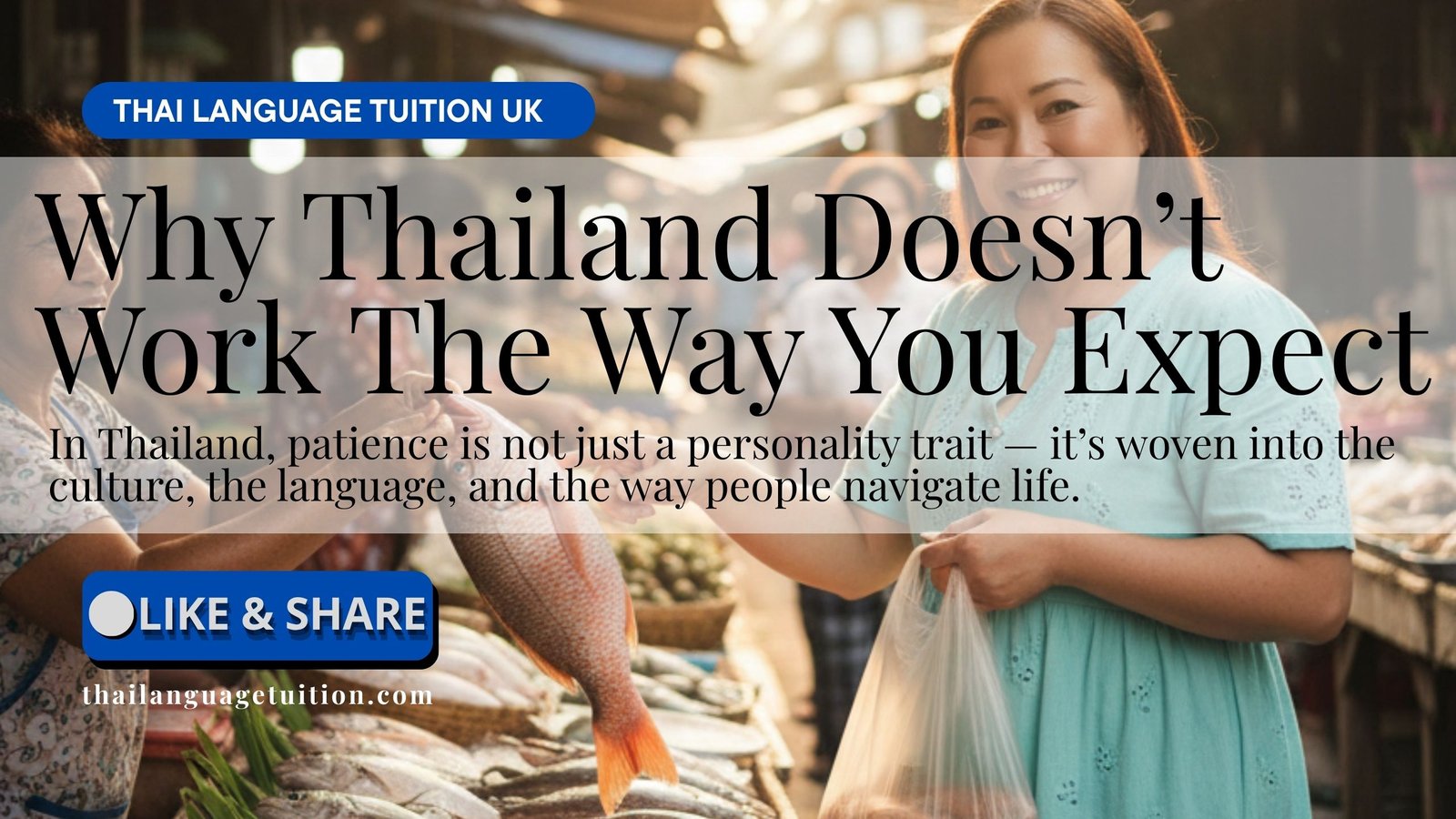
In Thailand, patience is not just a personality trait — it’s woven into the culture, the language, and the way people navigate life.
Many Western societies are built around systems. Rules are written clearly. Procedures are followed closely. Efficiency is often seen as a sign of competence. When something needs to be solved, the focus is usually on finding the fastest and most direct solution.
Thailand approaches things from a slightly different angle.
People come before process. While systems certainly exist, human relationships often play a much bigger role in how situation unfold. Tone of voice, respect, and the comfort level between people can influence the outcome just as much as the rules themselves.
This is why situations that seem simple on paper can sometimes take longer than expected. It’s not necessarily because people are disorganised or unwilling to help. More often, it’s because people are trying to handle the situation in a way that maintains harmony and respect — so no one is “sǐa-hnâa” (เสียหน้า), or “loses face”.
In Thai culture, the idea of “sǐa-hnâa” (เสียหน้า), or “losing face”, is taken very seriously. It refers to a situation when someone feels embarrassed, criticised, or publicly exposed in a way that damages their dignity. Because maintaining respect and social harmony is so important, people often try to avoid putting others in that position.
This is why disagreement are usually handled gently, and why criticism is often given in a softer, more indirect way. Sometimes people may even appear to agree in the moment, not because they truly intend to do so, but because they are trying to avoid open confrontation or causing someone to “sǐa-hnâa” (เสียหน้า) by refusing.
In Thailand, preserving harmony in the moment is often considered more important than winning an argument.
Another important part of Thai culture is hierarchy. Thai society places value on respect for age, experience, and social roles. This can be seen in everyday interactions — from the way people speak to elders, to how decisions are made in workplaces and organisations.
In many Western countries, communication tends to be more direct and informal. It is common for employees to openly question ideas, challenge decisions, or speak very casually with managers.
In Thailand, things often work a little differently.
People are usually more careful when speaking to someone who is older or in a higher position. Showing respect is considered important, and maintaining that respect helps preserve harmony within the group. Because of this, decisions may sometimes take longer, or discussions may happen more privately rather than openly challenging someone in front of others.
To outsiders, this can occasionally feel slow or unclear. But within the Thai culture context; it is part of maintain balance, respect, and social order.
The mistake many foreigners make is assuming Thailand should work like the West — just with better weather.
Thailand may not always operate according to Western expectations — and that’s the point. It simply reflects a culture that places strong value on respect, relationships, and social harmony. Once you begin to understand these cultural rhythms, Thailand stops feeling confusing and starts feeling remarkable.
Sometimes, it’s only when we step back and observe that we really see why things work the way they do.
About Post Author