Learning Thai language is a beautiful journey — one that unfolds in stages. Each level brings new challenges, new discoveries, and a growing sense of confidence. When you understand where you are on this path, it becomes easier to set goals, track your progress, and celebrate how far you’ve come.
The Common European Framework of Reference for Languages (CEFR) provides a helpful guide to describe your progress — from complete beginner to fluent communicator. But remember, these levels aren’t about labels or tests; they’re about directions. When you know where you are, it’s easier to see what you need next.
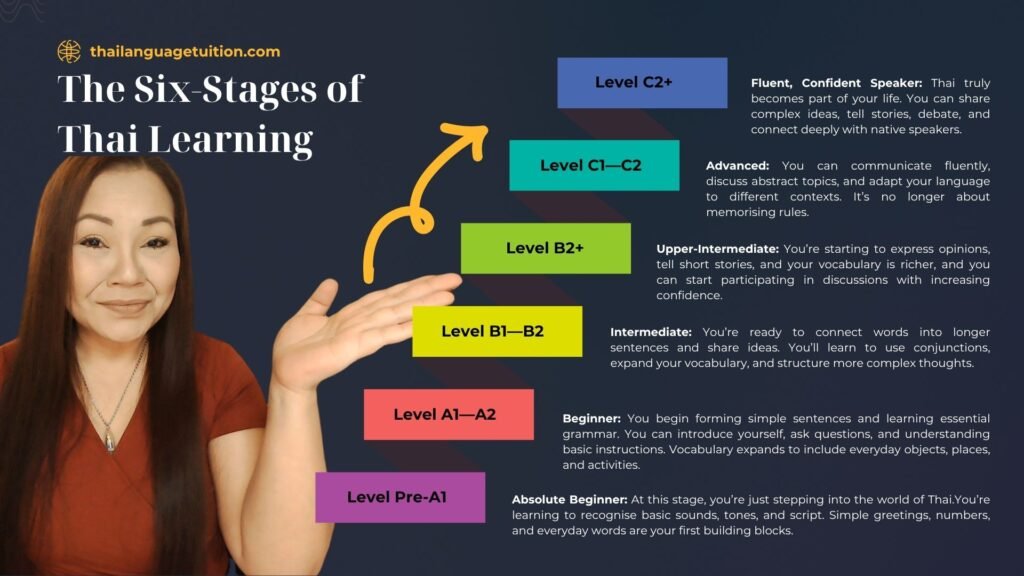
I also use these guidelines to create my six stages of teaching and learning Thai — from those first curious steps to full, confident expression. Every learner moves through them at their own pace, and sometimes you’ll find yourself revisiting earlier stages — and that’s completely natural. The truth is — language learning doesn’t happen in a straight line. It’s more like a circle, where you often need to go back and revisit what you’ve learned as you accumulate more vocabulary and grammar knowledge. Each time you return to a topic, you understand it a little better, see new connections, and use it more naturally. If you don’t keep revisiting and practising, it’s easy to forget — but when you do, your circle of knowledge keeps expanding, layer by layer.
Let’s take a look at what each stage means in the context of learning Thai:
Pre-A1 Level — Building Your Thai Foundation
Before you dive into full sentences and conversations, there’s a stage I like to call the building your Thai foundation phase — the Pre-A1 level. This is where we focus on laying a practical foundation that helps you start speaking Thai from day one. At this stage, I like to begin with basic vocabulary and expressions that allow you to talk about yourself and connect with others. We learn how to use personal pronouns, possessive pronouns, greetings, leave-taking expressions, days of the week, months of the year, and colours. These simple yet essential topics help you become familiar with basic sentence structures while building your confidence to speak. Once students can express simple ideas — introducing themselves, saying how they feel, or describing everyday things — I then bring in the Thai consonants and vowels. By this point, students already recognise familiar words by sound, which makes learning the script much easier and more meaningful. This stage is not just about memorising — it’s about building comfort and familiarity. You’re starting to understand how Thai sounds, how sentences are formed, and how to use words that describe your world. Learning in this way makes each new lesson feel connected to the last, reinforcing what you already know as you move forward. So, instead of rushing into reading and writing, this stage helps you listen, speak, and connect — preparing your ear, your memory, and your confidence for everything that comes next.
A1—A2 Levels — Expand Your Thai Word Bank
Once you’ve found your footing with the essentials, the next stage is all about expanding your foundation. At the A1—A2 levels, you begin to see how the pieces of the Thai language fit together — words, tones, and sentence patters start to make sense. At this stage, you’ll focus on learning to structure simple sentences, ask and answer everyday questions, and describe people, places, and things using vocabulary that’s relevant to your daily life. You’ll learn how to say where you are, what you like, what you do, and who you’re with — all through practical, real-life examples. Vocabulary continues to play a big role here. You’ll expand from simple nouns and verbs to useful expressions for daily routines, hobbies, food, and travel. Having a strong Thai word bank helps you express more ideas and reduce hesitation when speaking. That’s why I always encourage my students to keep reviewing and growing their Thai vocabulary lists — words are the building blocks that make communication possible. Grammar also becomes a friend rather than a fear. You’ll begin to recognise patterns — how sentences are formed, how questions are made, and understand why Thai sentences sound the way they do. By the end of A2, you’ll be able to talk about yourself more confidently, hold short conversations, and navigate simple social interactions in Thai. You may not be fluent yet, but you’ll have a solid structure that supports everything you’ll learn later. Learning Thai at this stage is like planting a garden — every new word is a seed, every sentence you make is a sprout, and with consistency, you’ll soon see how much has grown.
B1—B2 Levels — Connecting Ideas and Expressing Opinions
At this stage, learners begin to connect their words into longer, more meaningful sentences. You start to feel more confident expressing your ideas, not just describing what you see or do. This is where Thai becomes something you can think in, not just something you translate. You begin to express opinions, tell stories, and share experiences in your own way. As you move into the B1 level, the goal is to make your Thai more natural and connected. You start linking your thoughts with words like ‘because,’ ‘so,’ and ‘even though,’ building more complex structures and expressing reasons and emotions. You can describe your day, talk about your feelings, and share what you think about simple topics. This is often the stage where learners begin to see how tone and meaning work together — not just what words mean, but what they feel like when spoken in Thai. Then, as you grow into B2, your confidence deepens. You can take part in real conversations, express your opinions clearly, and talk about things that matter to you. You begin to sense the rhythm and flow of the Thai language — when to be polite, when to soften your words, and how to adjust your tone for different situations. You start to sound more like yourself in Thai, expressing not only what you know, but who you are. This is also the stage where mistakes are your best teachers. You might notice yourself mixing up tones or using the wrong connector, but that’s actually a good sign — it means you’re experimenting, stretching, and discovering how Thai truly works. The key is to keep learning new words, expanding your vocabulary, and revisiting what you’ve learned before. Every new word adds another layer to your understanding, and every conversation brings you closer to fluency.
B2+ — Expanding Confidence and Expression
At this stage, you’re no longer just forming sentences; you’re beginning to speak with nuance and flexibility. You can discuss familiar and less familiar topics, explain your ideas clearly, and adapt your language depending on the situation. You might find yourself thinking in Thai more often, rather than translating from English, and that’s a big step toward fluency. B2+ level is about expanding your vocabulary and experimenting with longer, more complex structures. You start linking ideas naturally, using conjunctions, descriptive phrases, and subtle tones to express your intention accurately. This is also the stage where mistakes become signs of growth — when you stretch your skills, try new words, and take risks in conversation. You begin to feel more confident in real-life interactions, whether ordering food in a busy market, giving directions, or discussing personal opinions with native speakers. It’s the stage where Thai starts to feel less like a foreign language and more like a tool for authentic expression. Even here, learning never stops. Building your vocabulary and practising regularly remains essential, because every new word opens doors to richer conversations and deeper understanding.
C1—C2 Levels — The Advanced Stage
By the time your each this stage, Thai begins to feel like a second skin — something that lives in you rather than something you have to reach for. You can express yourself with clarity and nuance, choosing words that match your emotions and intentions. At C1 level, you’re able to follow complex conversations, understand humour, and adapt your speech depending on who you’re talking to. You can share ideas, opinions, and even abstract thoughts with more confidence and flow. This level is all about refinement — polishing what you already know, adding depth to your Thai vocabulary, and exploring how tone and culture shape the way Thais communicate. You begin to understand idioms, subtle meanings, and cultural expressions that you might have missed before. You also start recognising how Thai people use language to express kindness, hierarchy, and emotion — and you naturally adjust your tone and word choice to match. At C2 level, or what I like to call the Proficiency Stage, your Thai becomes flexible and effortless. You can switch between formal and informal speech, interpret layers of meaning, and even play with language creatively — whether through jokes, storytelling, or teaching others. You no longer rely on translation; instead, you think, feel, and respond directly in Thai. But even at this stage, learning doesn’t stop. You keep discovering new expressions, new ways to describe emotions, and new cultural insights that make your Thai richer and more alive. It’s a never-ending circle of growth — because language, like life, keep evolving.
C2+ — The Fluent, Confident Speaker Stage
At this stage, Thai becomes more than just a language — it becomes a part of who you are. You no longer translate in your head or hesitate before you speak. Words flow naturally, guided by confidence and understanding. You can express yourself freely, tell stories, share opinions, and connect with people on a deeper level. You start to sense the rhythm and emotion behind Thai — how tone adds warmth, how phrasing shows respect, and how small expressions reveal big cultural meanings. It’s the point where you not only speak Thai but truly feel it. At this stage, you can move effortlessly between formal and casual speech, between everyday conversations and meaningful reflections. You notice how your voice adapts to different situations, and your confidence grows with every exchange. But even as a fluent speaker, the journey never really ends Each new words, each new conversation adds another layer of richness. Thai becomes something you live, breathe, and continue to discover — a lifelong relationship with the language and its people.
So, no matter what stage of Thai learning you’re in — from recognising your first tones to speaking with confidence — one thing remains true: Thai vocabulary is the heart of it all. Every new word you learn opens another doorway to understanding, expression, and connection. Keep building your Thai word bank little by little, and you’ll find that grammar, pronunciation, and fluency begin to flow more naturally. When you have words, you have the tools to think, feel, and communicate in Thai.
If you’re looking for ready-made vocabulary lists and Thai grammar lessons to support your learning journey, visit The Shop — you’ll find carefully designed learning materials to help you keep expanding your Thai knowledge.
So no matter what level, keep learning new words, keep practising, and enjoy the journey. Have a wonderful day, and I hope to see you inside my online classroom soon!
With all my heart, 💛 — Urai
Founder of Thai Language Tuition UK
You can also find my work at: uraikhomkham.com and shop.uraikhomkham.com
Join My newsletter
About Post Author