
Daily Thai Confidence — Using ลืม (lēum)
In this Thai lesson, we learn how to use the verb ลืม (lēum), which means ‘to forget’. It is used when someone does not remember a person, thing, action, information, or obligation.
In this Thai lesson, we learn how to use the verb ลืม (lēum), which means ‘to forget’. It is used when someone does not remember a person, thing, action, information, or obligation.
In this Thai lesson, we learn how to use the adjective น่าเสียดาย (nâa-sǐa-dāai), which can be translated as ‘what a pity,’ ‘it’s a shame,’ or ‘unfortunate’. It is used to express regret, disappointment, or sympathy about a situation that did not turn out well.
Daily Thai Confidence — Using น่าเสียดาย (nâa-sǐa-dāai) Read More »
In this Thai lesson, we learn how to use the adverb ค่อนข้าง (khâwn-khâang), which is commonly translated as ‘quite,’ ‘rather,’ or ‘fairly’. It is used to describe a moderate degree of something.
Daily Thai Confidence — Using ค่อนข้าง (khâwn-khâang) Read More »
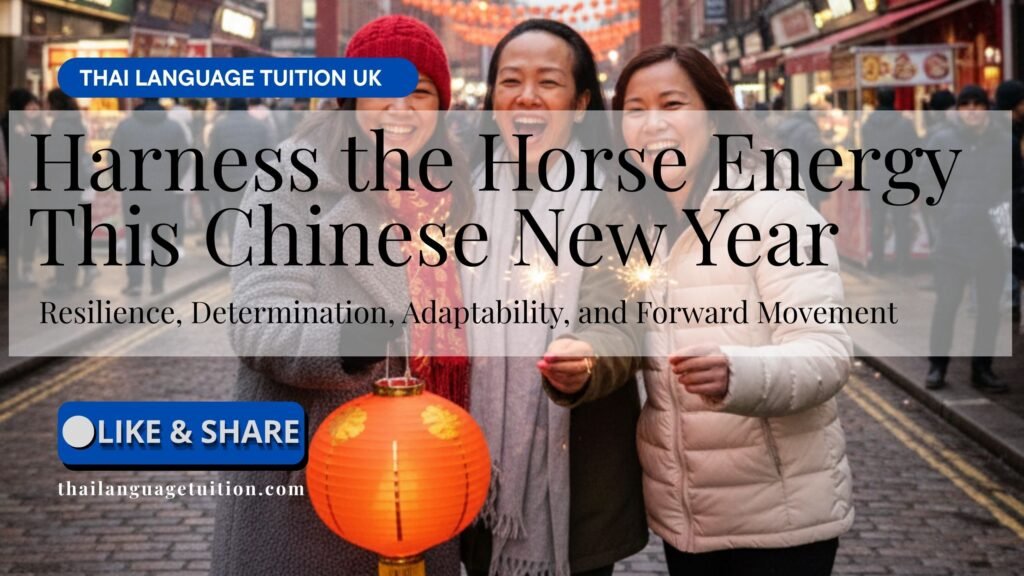
This Chinese New Year welcomes the Year of the Horse — a symbol of resilience, determination, adaptability, and forward movement. This year is about momentum — not rushing, but trusting your direction and having the stamina to keep going, even when the road feels long and challenging.
In this Thai lesson, we learn how to use the adverb แค่ (khâe), which means ‘only,’ ‘just,’ or ‘merely’. It is used to emphasise limitation or smallness of quantity, amount, or degree.
In this Thai lesson, we learn how to use the verb เริ่ม (rêuhm), which means ‘to start’ or ‘to begin’. It is used to talk about the beginning of an action, event, process, or situation.

Life is busy — I know that more than anyone. Work, family, responsibilities… the days move quickly, and before you know it, it’s evening. You’re exhausted, your energy is low, and relaxing feels far more appealing than opening your Thai learning notes. But we all have 15 minutes.

สุขสันต์วันแห่งความรักค่ะทุกคน (sùk-sǎn wān hàeng khwāam-rák khâ thúk-khōn) — Happy Valentine’s Day everyone! If you’re in the mood to learn something new, below is a list of Thai words connected to love, care, and appreciation — a small way to add meaning to today and maybe create a new memory of your own.
In this Thai lesson, we will learn how to use the word รุ่น (rûn), which is used to talk about people or things that belong to the same time, age group, or production period.
In this Thai lesson, we will learn how to use the verb phrase จำเป็นต้อง (jām-bpēn dtâwng), which is used to express strong necessity. It is stronger and more formal than ต้อง (dtâwng).
Daily Thai Confidence — Using จำเป็นต้อง (jām-bpēn dtâwng) Read More »
Modal Verb: ต้อง (dtâwng)Meaning: must / have to / need to / required to In this Thai lesson, we will
In this Thai lesson, we will learn how to use the word มี (mēe) to mean ‘there is,’ ‘there are,’ ‘there was,’ or ‘there were’. When the word มี (mēe) is used in this way, the speaker is introducing new information — something that appears, exists, or can be found.
