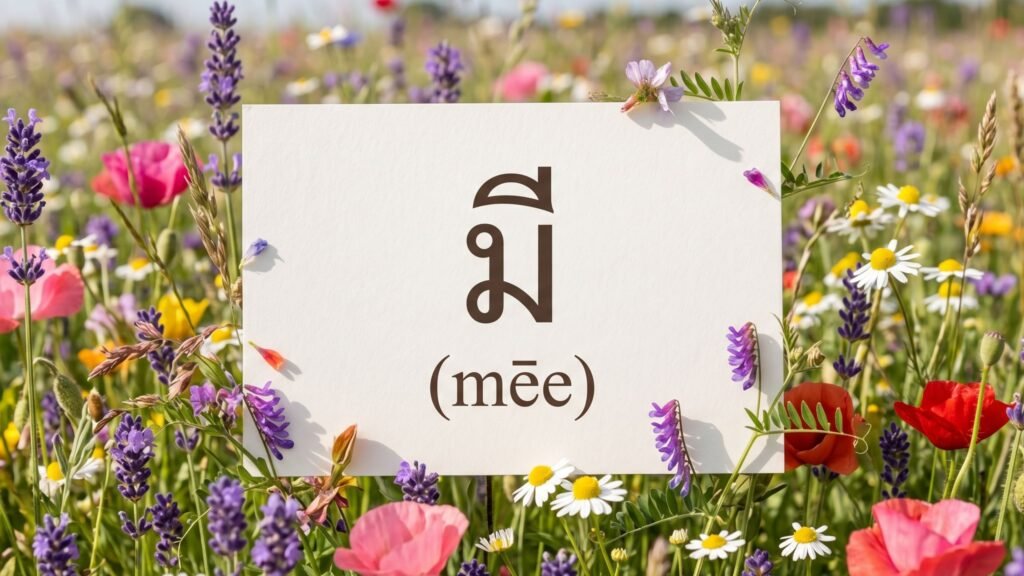
Verb: เริ่ม (rêuhm)
Meaning: to start / to begin
In this Thai lesson, we learn how to use the verb เริ่ม (rêuhm), which means ‘to start’ or ‘to begin’. It is used to talk about the beginning of an action, event, process, or situation. Since เริ่ม (rêuhm) is a verb, it is placed after the subject of the sentence (ประธานของประโยค — bprà-thāan khǎwng bprà-yôok). It is usually followed by another verb or by a noun phrase. Optional complements, such as time, reason, or additional details, can be added to give more information about what is starting.
The typical structure usually follows the pattern: subject (+ helping verb) + เริ่ม (rêuhm) + verb / verb phrase / noun phrase (+ complement (a clause or a phrase that give more information about what is starting).
For examples (ตัวอย่างเช่น — dtūa-awyàang chên)
ผมจะเริ่มเรียนภาษาไทยเดือนนี้
phǒm jà rêuhm rīan phāa-sǎa Thāi dēuan née
Literal: I will start learn language Thai month this.
I will start learning Thai this month.
The main clause ผมจะเริ่มเรียนภาษาไทย (phǒm jà rêuhm rīan phāa-sǎa Thāi = I will start learning Thai) is structurally complete on its own. The time adverbial phrase เดือนนี้ (dēuan née = this month) is added to give more information about when the action will begin.
เขาจะเริ่มทำงานที่บริษัทใหม่ตอนต้นเดือนหน้า
khǎo jà rêuhm thām-ngāan thêe bāw-rí-sàd hmài dtāwn dtôn dēuan hnâa
Literal: He will start do-work at company new at beginning month next.
He will start working at a new company at the beginning of next month.
The main clause เขาจะเริ่มทำงานที่บริษัทใหม่ (khǎo jà rêuhm thām-ngāan thêe bāw-rí-sàd hmài = he will start working at a new company) is structurally complete on its own. The time adverbial phrase ตอนต้นเดือนหน้า (dtāwn dtôn dēuan hnâa = at the beginning of next month) is added to give more information about when the action will begin. Please note: The word ที่ (thêe = at / in) is a preposition of place used to indicate the location where someone or something exists, happens, or is situated. It is placed before a noun or noun phrase that specifies the place — ที่ (thêe) + location. Whereas the word ตอน (dtāwn = at / in) is a preposition of time used to indicate when an event or action takes place. It is placed before a noun or noun phrase that specifies the time — ตอน (dtāwn) + time expression.
เธอเริ่มออกกำลังกายทุกวันเพราะว่าเธออยากแข็งแรง
thēr rêuhm àwk-gām-lāng-gāai thùk wān phrót wâa thēr awyàak khǎeng-rāeng
Literal: She start out-strength-body every day because of she want to be strong and healthy.
She started exercising every day because she wants to be strong and healthy.
The main clause เธอเริ่มออกกำลังกาย (thēr rêuhm àwk-gām-lāng-gāai = she started exercising) is structurally complete on its own. The frequency adverbial phrase ทุกวัน (thúk wān = every day) is added to give more information about how often the action happens. The reason clause เพราะว่าเธออยากแข็งแรง (phrót wâa thēr awyàak khǎeng-rāeng = because she wants to be strong and healthy) explains the motivation for starting the action. Please note: The verb phrase ออกกำลังกาย (àwk-gām-lāng-gāai) means ‘to exercise’ or ‘to workout’ and refers to activities that use physical effort to improve or maintain health, fitness, or strength.
พวกเราต้องเริ่มเตรียมตัวสำหรับการเดินทางคืนนี้
phûak-rāo dtâwng rêuhm dtrīam-dtūa sǎm-hràb gāan-dēuhn-thāang khēun-née
Literal: We must start prepare-oneself for journey night-this.
We must start preparing ourselves for the journey tonight.
The main clause พวกเราต้องเริ่มเตรียมตัว (phûak-rāo dtâwng rêuhm dtrīam-dtūa = we must start preparing ourselves) is structurally complete on its own. The prepositional phrase สำหรับการเดินทาง (sǎm-hràb gāan-dēuhn-thāang = for the journey) is added to explain the purpose of the action. The time adverbial คืนนี้ (khēun-née = tonight) gives additional information about when the action should begin. Please note: The verb phrase เตรียมตัว (dtrīam) means ‘to prepare’ or ‘to get ready’. It is often combined with other words to specify what you are preparing for, such as an event, task, trip, or activity. For example: เตรียมตัว (dtrīam-dtua = to prepare oneself / to get oneself ready (for something)); เตรียมอาหารเย็น (dtrīam āa-hǎan-yēn = to prepare dinner); เตรียมกระเป๋าเดินทาง (dtrīam grà-bpáo dēuhn-thāang = to prepare the suitcase); เตรียมเอกสาร (dtrīam àek-gà-sǎan = to prepare the documents); เตรียมอุปกรณ์ (dtrīam ùb-bpà-gōrn = to prepare equipment); เตรียมของขวัญวันเกิด (dtrīam khǎwng-khwǎn wān-gèud = to prepare a birthday present); เตรียมแบบฝึกหัด (dtrīam bàeb-fèuk-hàd = to prepare practice exercises) etc.
Homework (การบ้าน — gāan-bâan)
Practise putting your newly learned Thai word into a sentence by translating the following sentences below.
- She starts exercising every morning.
- He started reading a new book yesterday.
- We will start the meeting at 9 a.m.
- I will start cooking dinner at 6 p.m.
- We have to start cleaning the house before the guests arrive.
About Post Author