
May 2026

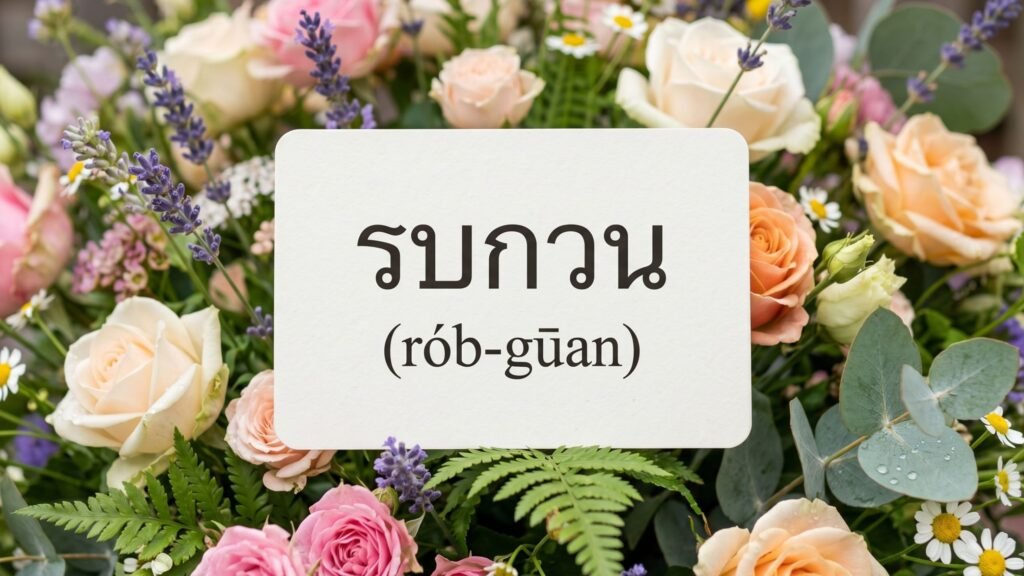
Daily Thai Confidence — Using รบกวน (rób-gūan)

In this Thai lesson, we learn how to use the noun รบกวน (rób-gūan), which means ‘to disturb,’ ‘to interrupt,’ or ‘to bother someone,’ especially by affecting their time, attention, or peace. It is also commonly used as a polite word to make request softer, similar to “could you please…” or “may I trouble you…” in English.


Daily Thai Confidence — Using รบกวน (rób-gūan) Read More »

Daily Thai Confidence — Using เย็นสบาย (yēn-sà-bāai)

In this Thai lesson, we learn how to use the adjective เย็นสบาย (yēn-sà-bāai), which means ‘cool and comfortable’ or ‘pleasantly cool.’ It is used to describe weather or places that feel refreshingly cool and relaxing. It gives a positive feeling — not just “cold,” but comfortably cool.

Daily Thai Confidence — Using เย็นสบาย (yēn-sà-bāai) Read More »

Daily Thai Confidence — Using ทะเล (thá-lāy)

In this Thai lesson, we learn how to use the noun ทะเล (thá-lāy), which means ‘sea’ or ‘seaside.’ It refers to the large body of salt water that covers most of the Earth’s surface and is connected to beaches and coastal areas. It is a very common word in everyday Thai, especially when talking about travel, holidays, and nature.

Daily Thai Confidence — Using ทะเล (thá-lāy) Read More »

Daily Thai Confidence — Using ข้อมูล (khâw-mūun)

In this Thai lesson, we learn how to use the adjective ข้อมูล (khâw-mūun), which means ‘information,’ ‘data,’ ‘details,’ or ‘facts.’ It refers to knowledge, facts, statistics, or content that is collected, given, shared, or used for understanding, communication, analysis, or decision-making.

Daily Thai Confidence — Using ข้อมูล (khâw-mūun) Read More »

Daily Thai Confidence — Using ปมด้อย (bpōm-dôi)

In this Thai lesson, we learn how to use the noun ปมด้อย (bpōm-dôi), which means ‘inferiority complex,’ ‘insecurity,’ ‘a feeling of personal inadequacy,’ or ‘a psychological sense of being not good enough.’ It refers to a deep psychological sense of inferiority or insecurity, where a person feels they are lacking or not good enough in comparison to others, often shaped by experience and self-perception.

Daily Thai Confidence — Using ปมด้อย (bpōm-dôi) Read More »

Daily Thai Confidence — Using ทีละนิดทีละหน่อย (thêe-lá-níd-thêe-lá-hnòi)

In this Thai lesson, we learn how to use the adverbial phrase ทีละนิดทีละหน่อย (thêe-lá-níd-thêe-lá-hnòi), which means ‘little by little,’ ‘bit by bit,’ or ‘gradually.’ It is used to describe an action, process, or change that happens very gradually in small, repeated steps over time, rather than all at once. It emphasises the ideal of progress through tiny increments, often suggesting patience, consistency, and a natural unfolding of change.

Daily Thai Confidence — Using ทีละนิดทีละหน่อย (thêe-lá-níd-thêe-lá-hnòi) Read More »

Daily Thai Confidence — Using สะกิดใจ (sà-gìd jāi)

In this Thai lesson, we learn how to use the verb สะกิดใจ (sà-gìd jāi), which means ‘to sudden dawn on’ or ‘to strike a chord.’ It refers to a subtle emotional or mental nudge that triggers sudden awareness, reflection, or emotional response. It describes the moment when something gently but meaningfully touched the mind or heart, causing a person to notice, feel, or realise something more deeply than before.

Daily Thai Confidence — Using สะกิดใจ (sà-gìd jāi) Read More »

Daily Thai Confidence — Using มัวแต่ (mūa-dtàe)

In this Thai lesson, we learn how to use the verb มัวแต่ (mūa-dtàe), which means ‘to keep doing one thing so much that other things are neglected’ or ‘to be so busy doing one thing that other things are not getting done.’ This verb phrase is used to describe someone who is overfocused on one thing, often to the point that they ignore something more important.

Daily Thai Confidence — Using มัวแต่ (mūa-dtàe) Read More »

Daily Thai Confidence — Using จับผิด (jàb-phìd)

In this Thai lesson, we learn how to use the verb จับผิด (jàb-phìd), which means ‘to find fault,’ ‘to criticise,’ or ‘to pick on.’ It is used when someone pays close attention in order to criticise, point out mistakes, or catch someone doing something wrong.

Daily Thai Confidence — Using จับผิด (jàb-phìd) Read More »

error: Content is protected !!