

Daily Thai Confidence — Using รอ (rāw)
In this Thai lesson, we learn how to use the verb รอ (rāw), which means ‘to wait’. It is used whenever someone pauses or waits for something to happen or for someone to arrive.
In this Thai lesson, we learn how to use the verb รอ (rāw), which means ‘to wait’. It is used whenever someone pauses or waits for something to happen or for someone to arrive.

In this Thai lesson, we learn how to use the verb ดู (dūu) as a complementary verb, which is used along another verb when we want to soften a suggestion. In this usage, it is like saying ‘try doing it (the verb that comes before it) and see what happens’.
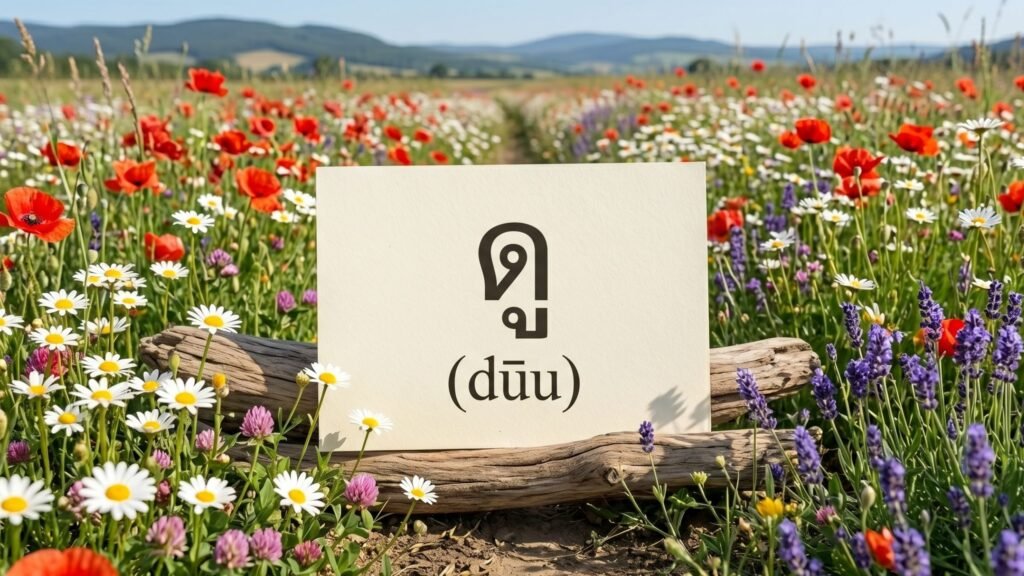
In this Thai lesson, we learn how to use the verb ดู (dūu), which can be translated to ‘to look’ or ‘to watch’. It is a common and versatile verb used when talking about seeing something with your eyes, watching television or films, checking or examining something, or describing how someone appears.

In this Thai lesson, we learn how to use the verb เฝ้า (fâo), which can be translated as ‘to stay with,’ ‘to watch over,’ or ‘to keep close supervision of someone or something’.

You want to start learning Thai… but you’re not quite sure where to begin? With so many books, apps, videos, and advice available out there, choosing a starting point can feel overwhelming.

In this Thai lesson, we learn how to use the noun แม่น้ำ (mâe-nám), which means ‘river’. It refers to a large natural flow of water that moves continuously and usually flows into the sea, a lake, or another river.

In this Thai lesson, we learn how to use the relative clause ที่ผ่านมา (thêe phàan māa), which means ‘that has passed’ or ‘during the past period’. It is commonly used after time words to form an adverbial phrase of time referring to a period of time before now
Daily Thai Confidence — Using ที่ผ่านมา (thêe phàan māa) Read More »

In this Thai lesson, we learn how to use the verb ตัดสินใจ (dtàd-sǐn-jāi), which means ‘to decide’ or ‘to make a decision’. It is used when someone chooses one option after thinking, considering, or weighing possibilities.
Daily Thai Confidence — Using ตัดสินใจ (dtàd-sǐn-jāi) Read More »

In this Thai lesson, we learn how to use the verb ลืม (lēum), which means ‘to forget’. It is used when someone does not remember a person, thing, action, information, or obligation.

In this Thai lesson, we learn how to use the adjective น่าเสียดาย (nâa-sǐa-dāai), which can be translated as ‘what a pity,’ ‘it’s a shame,’ or ‘unfortunate’. It is used to express regret, disappointment, or sympathy about a situation that did not turn out well.
Daily Thai Confidence — Using น่าเสียดาย (nâa-sǐa-dāai) Read More »

In this Thai lesson, we learn how to use the adverb ค่อนข้าง (khâwn-khâang), which is commonly translated as ‘quite,’ ‘rather,’ or ‘fairly’. It is used to describe a moderate degree of something.
Daily Thai Confidence — Using ค่อนข้าง (khâwn-khâang) Read More »